
Capital inflows to Canadian managers showcase investor confidence as buyouts a comforting alternative in a turbulent market
Capital inflows to Canadian managers showcase investor confidence as buyouts a comforting alternative in a turbulent market

Assets managed by Canadian private equity managers experienced incredible growth in 2022, though not without concern. Such capital flows could lead to frothy markets and accompanying crashes as valuations correct to a more natural level. However, buyouts offer a strategic option for apprehensive investors.
Last year, Canadian managers saw large inflows of capital − a pattern that has been seen before. Specifically, 2013, 2016, and 2019 recorded new peaks in terms of inflows. Aggregate capital raised achieved a record high of $45bn in 2022 (Fig. 1). Meanwhile, dry powder fell from more than 57% in 2019 to less than 45% of AUM as of June 2022. In 2022, this three-year pattern occurred again with record inflows of capital raised, but dry powder remained at about 42% − only slightly above the low recorded in 2021. These bursts indicate a vote of confidence in managers in the region.
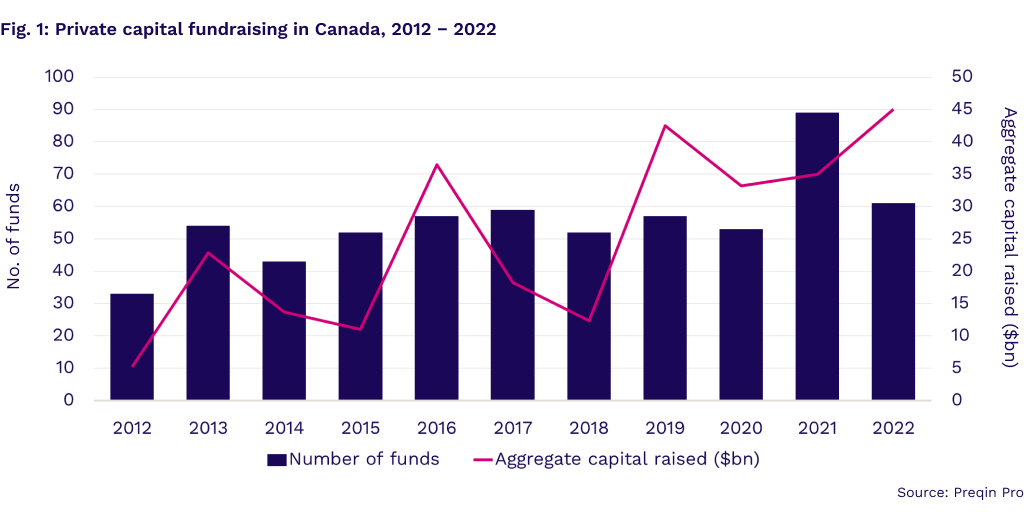
At first glance, it may appear that managers are putting capital to work haphazardly, as this is an obvious deviation from the rest of the decade. But looking at the venture market, it makes sense. In the recent past, there have been blow-ups in (retrospectively) top-of-the-market start-up fundings, such as for Celsius and FTX, which had both attracted money from noted Canadian institutional investors. A global venture malaise set in as investors seemed to forgo FOMO (fear of missing out) for FOGA (fear of getting annihilated). However, what is more apparent is that these strong inflows to Canadian managers during this trying time exemplify investors’ confidence in investee companies, as managers deployed this capital to deserving targets. Historically, one sure way to miss out on excellent long-term returns is to eschew vintage diversification (or investing each year, no matter the investment climate) when the going gets rough. Thankfully, it seems as if investors have learned this lesson by putting money into funds, and managers have done the same by pulling the trigger on opportunities instead of pulling the plug and possibly missing out.
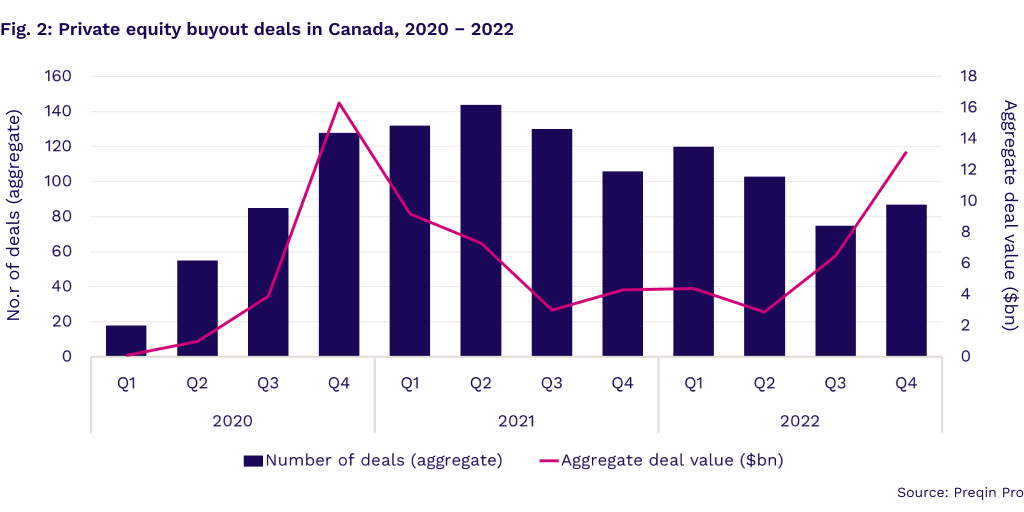
While fundraising achieved new highs, there has been some apprehension as to whether buyout deal growth will continue. Buyout deals saw significant expansion in the last three quarters of 2022, rising in value to $13.2bn in the fourth quarter from $2.9bn in the second (Fig. 2). Despite this growth, rate rises could cause a drop in value, with deals being reworked as margins of underlying businesses and financing costs become challenging. It would not be surprising to see a possible hangover from such record aggregate deal value growth.
These developments come at a time when fund managers are tasked with maneuvering a tumultuous market. The stockpile of dry powder and capital raised signal investor confidence in Canadian managers.
Time will tell if managers have chosen well by investing with record inflows in 2022 and shying away from leveraged buyout deals in early 2023. Performance will be a key indicator to see if asset allocation strategies pan out over the next few years – as will the investors who are committed to these closed-end, longer-term vehicles.
About
James Burron co-founded CAASA in response to industry support for a Canadian alternatives association to serve all aspects of the alternatives industry with the motto of “bringing Canada to the world and the world to Canada”. CAASA currently has more than 350 members and continues to grow as those within and outside Canada join.
Prior to CAASA, James was the Chief Operating Officer of AIMA Canada for seven years, during which his team produced dozens of events each year and founded the AIMA Canada Investor Forum, leading to a near tripling of membership to 164 on his departure.
James also has experience in research and writing for the CAIA Association (holding the designation since 2006), as well as serving on CAIA’s exam council. Among other duties, he is sought after for speaking and moderating roles at the 30 conferences he attends each year.