Marissa Lee
|
Healthcare deal activity picked up in 2020, with life sciences and pharmaceuticals investment momentum expected to remain strong post-COVID-19
Healthcare deal activity picked up in 2020, with life sciences and pharmaceuticals investment momentum expected to remain strong post-COVID-19
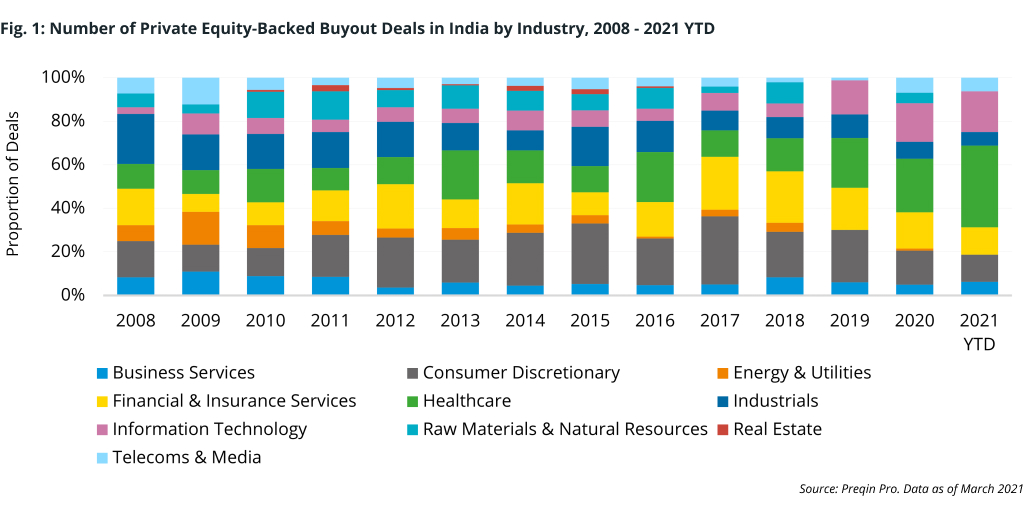
Despite a global slowdown in 2020, private equity-backed buyout activity trended upwards in India. More than 100 deals were transacted, worth a combined $20bn, up from 83 deals worth $7.0bn in 2019. While 2020’s figure would have been much smaller if not for a $17bn boost from investments in telecoms network Jio Platforms and sister company Reliance Retail, the healthcare sector recorded a notable uptick.
As shown in Fig. 1, the largest proportion of buyout deals in India tracked by Preqin in 2020 were healthcare deals, spanning the pharmaceuticals, chemicals, and biotech industries. Some $2.4bn was invested across 31 healthcare deals in 2020, up from $1.1bn invested across 24 deals in 2019.
The largest healthcare deal of 2020 was KKR’s purchase of a controlling stake in publicly listed J. B. Chemicals & Pharmaceuticals for $500mn, followed by Carlyle Group’s acquisition of a 20% stake in Piramal Pharma for $490mn. Earlier that year, Carlyle also agreed to buy up to 74% of SeQuent Scientific, the largest pure-play animal healthcare company in India, for $216mn.
While average deal sizes in healthcare tend to be smaller than in the financial services or technology sectors, we expect renewed interest and more robust deal activity in the Indian life sciences space going forward. The ongoing pandemic has brought life sciences supply chains, drug development, and R&D into the global spotlight, as nations and companies scramble to strengthen critical healthcare infrastructure. With India occupying one of the top spots for the production of generic drugs globally, and serving as a supplier of 50% of the world’s vaccines, the country occupies a uniquely competitive position.
There will be other tailwinds for supportive private capital investment, too. Contract research and manufacturing services (CRAMS) – a business model where innovator companies focus on new drug discovery while outsourcing key ancillary activities – are growing in prominence. According to a 2021 report by consultancy giant EY, the shift toward CRAMS by life sciences companies enables asset-light operations by freeing up resources for R&D efforts. This has helped unlock the potential of value chains and opened the door for specialized companies in India to emerge in the industry. The report details how India “has benefited greatly from this trend leading to an expansion in revenues/margins and valuations of small and big players alike in the sector.”
Investment momentum has continued into 2021. In the first three months of the year, Preqin recorded seven healthcare deals in India with an aggregate value of $436mn. In February, Advent International agreed to fully acquire ZCL Chemicals, one of India’s fastest-growing pharma companies, from Morgan Stanley Private Equity Asia for INR 20bn ($275mn).
Looking ahead to the rest of the year, the Indian Government’s production-linked incentive (PLI) scheme is expected to bring in investment of INR 15,000 crore in the pharmaceutical sector, with the aim of turning India into a global hub for making bulk drugs and medical devices.
For GPs with the right domain expertise, this presents an interesting opportunity to participate in drug innovation and manufacturing. The COVID-19 outbreak tested the world’s medicine supply chains, and became a driving force for countries like India to work on being more self-reliant for their pharmaceutical needs. With case counts rising especially dramatically in India, the global recovery effort could be under threat. Private capital now more than ever could play a supportive role in bolstering healthcare capacity for the benefit of all.