
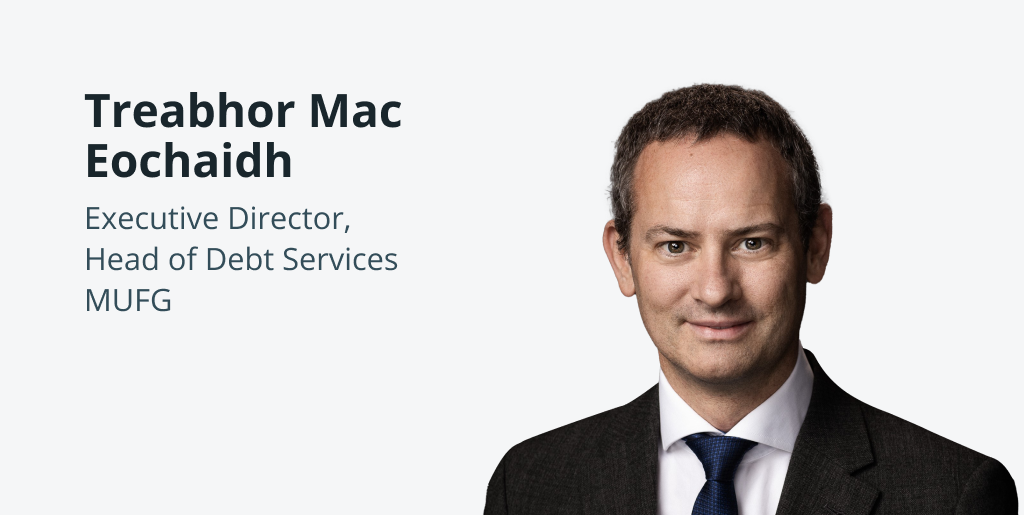
MUFG’s Treabhor Mac Eochaidh discusses the evolving private credit market as it finds a global reach
Private debt continues to attract investors as its reputation for being a high-yield asset class with favorable risk-adjusted returns increases. This growing popularity has also been driven by private debt’s practicality in an environment where public debt is offering comparatively less to investors. Like public debt, private debt’s low correlation to equity strategies places it well in an institutional portfolio, but manager/lender discretion allows for tailored individual investments to better manage idiosyncratic risk.
This increased interest and growth has propelled private debt into a truly global asset class. Even as the US market remains the stronghold of this space, particularly Silicon Valley, EMEA is continuing to grow with the Middle East set to boom. APAC is also seeing significant activity in new pockets across Southeast Asia and India as the private debt markets in China, Hong Kong, Singapore, and Australia are maturing. The asset class is also experiencing growth in the South American region.
US looks to balance equity and debt
Globally, the US will continue dominate the direct lending space. Low interest rates and bank regulations have made investors and portfolio companies very comfortable with private lenders in the years following the Global Financial Crisis. As such, LPs have found balancing their private equity allocations with private debt interest streams has boosted their portfolios beyond traditional public-asset strategies, and private debt targets have grown accordingly.
But as this market has grown, private lending in the US has become competitive. This competition has consequently driven up deal valuations and put downward pressure on yields. While Europe still looks attractive, especially at the mezzanine level, one region we have seen piquing investors’ interest has been the mid-cap market in the Middle East. With many investment managers expanding into the region, the market is increasing its presence in private debt opportunities.
APAC is becoming easier to do business in for many private lenders, but the market is segmented. Asian banks were overall better capitalized in 2008 but current risk from regulatory scrutiny is affecting capital requirements, forcing them to hold more capital against loans. Singapore and Hong Kong remain jurisdiction hubs for credit managers looking at private debt. India and Southeast Asia are becoming more tax transparent, and the legal framework is changing to offer better protection for lenders. Overall, they are getting easier to do business with and are attracting much-needed foreign investment.
Opportunity and necessity will continue to drive private credit’s expansion beyond the borders of its traditional home in the US market. The growth of private credit assets, an estimated $1.25tn according to the most recent Preqin data, has made a decade-long test case for managers looking to expand into regions outside the US, where many of the forces that drove that growth are beginning to show up. With increasing regulatory pressures in APAC and the EU, high inflation will also push assets away from public credit mandates and into private credit allocations.
About
Treabhor brings unique insight into how to service direct lending funds and manage loan services. Treabhor is responsible for Direct Lending, Syndicated and Distressed Loan Administration. He joined MUFG Investor Services from Citco where most recently he was head of Loan Services for EMEA. Prior to that Treabhor worked in a range of senior roles in Direct Lending and loan-related functions, as well as client service and risk at State Street, JP Morgan, and Bank of New York.