
With the pandemic changing the game for secondaries, we asked Matthew Sparks, Managing Director at Northleaf, why the market is an increasingly attractive option for GPs
With the pandemic changing the game for secondaries, we asked Matthew Sparks, Managing Director at Northleaf, why the market is an increasingly attractive option for GPs
Capital flows into secondaries have continued to rise, amounting to $83bn in 2020 and reaching $31bn so far in 2021, according to Preqin data. What is driving this growth, and could the market be overcapitalized?
The significant capital inflows are driven by the strong benefits of the asset class. Secondaries provide investors with diversified private equity exposure – reached at an accelerated pace – as well as the mitigation or elimination of the J-curve, attractive returns, and early cash back. This has been further buoyed by strong investor sentiment regarding alternative assets as a whole, as evidenced by Preqin’s H1 2021 Investor Outlook, in which 44% of investors said they planned to invest more capital in private equity – secondaries are well placed to benefit from this.
The increase in deal volume is also supporting a greater number of capital commitments to secondaries. The secondary market is a critical portfolio management tool which allows GPs to sell non-core assets or reduce NAV exposure to certain funds or sectors – a valuable option for a CIO. GPs are increasingly utilizing the secondary market to optimize their portfolios and provide liquidity options to their LPs. We expect these growth drivers to support the market for years to come.
Despite strong capital inflows, the growth of the market and pace of deal flow suggest the market remains undercapitalized. Preqin estimates that secondary players hold $127bn of dry powder, which compares with projected market volume for 2021 of $75bn to $100bn. This means the market will be out of capital in less than two years unless additional commitments are raised.
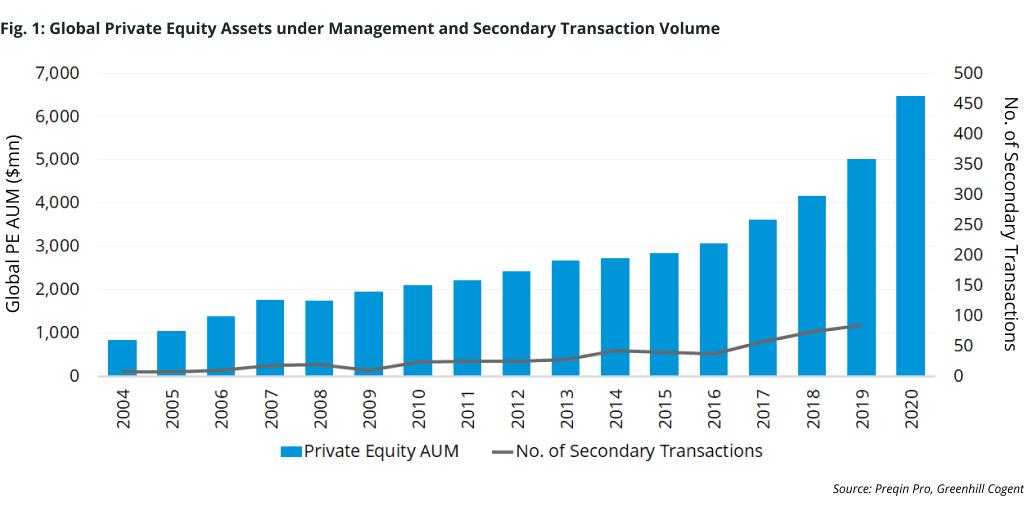
The size of the broader private equity market supports the further growth of secondaries. With current private equity net assets under management of $6.47tn according to Preqin (Fig. 1), a turnover rate of only 1.5% is required to support current market volume. We believe the turnover rate will continue to increase as both LPs and GPs utilize secondaries for liquidity.
GP-led transactions in particular have surged in the past year and represented about half of all secondary volume. Why are GPs selling as the market recovers from last year’s downturn?
Using the secondary market as a tool to manage businesses and funds became particularly acute for GPs at the onset of the COVID-19 pandemic. In the early innings, many companies needed capital to defensively shore up their balance sheets or to offensively take advantage of growth opportunities. Some needed more time to execute their investment theses.
Over the past 18 months or so, we have seen an increase in continuation fund structures, where GPs offer LPs liquidity while raising additional capital and creating more time to pursue their value creation plan. This liquidity option was well received by LPs who understood that extended holding periods might mean distributions would take longer to materialize.
With the right dynamics, secondary transactions are a compelling buyside opportunity. We can invest in a strongly performing asset and support its next phase of growth with a GP that has already worked extensively with the company. In these situations, the GPs are not selling, but are in fact doubling down on their assets with significant roll - or investing more capital - in their commitments. In addition, they are also taking the carried interest generated from LP sale proceeds to further invest in the deal. In short, GPs are putting more capital into continuation funds than they are taking out.
In what other ways have GPs evolved their thinking in regard to the secondary market?
As GPs better understand the secondary market, they are becoming more active. Today, GPs understand the importance of their LP bases and are much more active when an LP interest goes to market. Therefore, a GP may restrict the potential buyer set or seek support for its current fundraising in the form of a staple commitment, recognizing that not all buyers are created equal.
GPs have also learned that the secondary market is a flexible source of capital that can provide solutions beyond the purchase of an LP stake. They are looking to the secondary market for continuation vehicles, but also to provide preferred equity at the company or the fund level and, in some cases, to purchase a stake in their firm.
Northleaf Capital has benefited greatly from these dynamics. By offering a wide range of capital products for GPs, our active primary program positions us well as a replacement LP. One particular area in which we are seeing greater interest is our value-add capacity as an LP through our ability to lead continuation fund transactions, provide direct or preferred equity, and offer credit solutions through our Private Credit program.
We expect GPs to increasingly focus on their LP base as a resource, beyond the initial capital commitment, and a differentiating factor in a very competitive buyout market.
About Matthew Sparks
Matthew participates in all aspects of Northleaf’s private equity investment activities, with a focus on the origination, evaluation, and monitoring of secondary investments.
Prior to joining Northleaf in 2010, Matthew was a consultant with Monitor Group where he worked on various acquisition, due diligence, growth strategy, and post-merger integration projects for clients in a range of industries, including media, retail, and business outsourcing. Matthew received an H.B.A. (Business) with distinction from the Ivey Business School, University of Western Ontario.
This article originally appeared in the Preqin Secondary Market Update, H2 2021. The opinions and facts included within the above do not constitute investment advice. Professional advice should be sought before making any investment or other decisions. Preqin and Northleaf Capital Partners providing the information in this content accept no liability for any decisions taken in relation to the above.