
Venture capital investment in healthtech hit $8.2bn in Q1 2020, the highest quarterly total on record – and large deals continue to be made
Venture capital investment in healthtech hit $8.2bn in Q1 2020, the highest quarterly total on record – and large deals continue to be made
Venture capital-backed healthtech deal values are soaring, highlighting a key trend that’s being accelerated by COVID-19: the consumerization of healthcare. Amid a global lockdown, demand for digitally accessible healthcare products and services is on the rise. With entire populations sheltering in place at home, governments across the globe are lowering regulatory barriers that have long impeded the provision of digital healthcare services such as virtual medical appointments, for example. These policy changes could help to spur even more investor interest in healthtech, according to Deloitte.
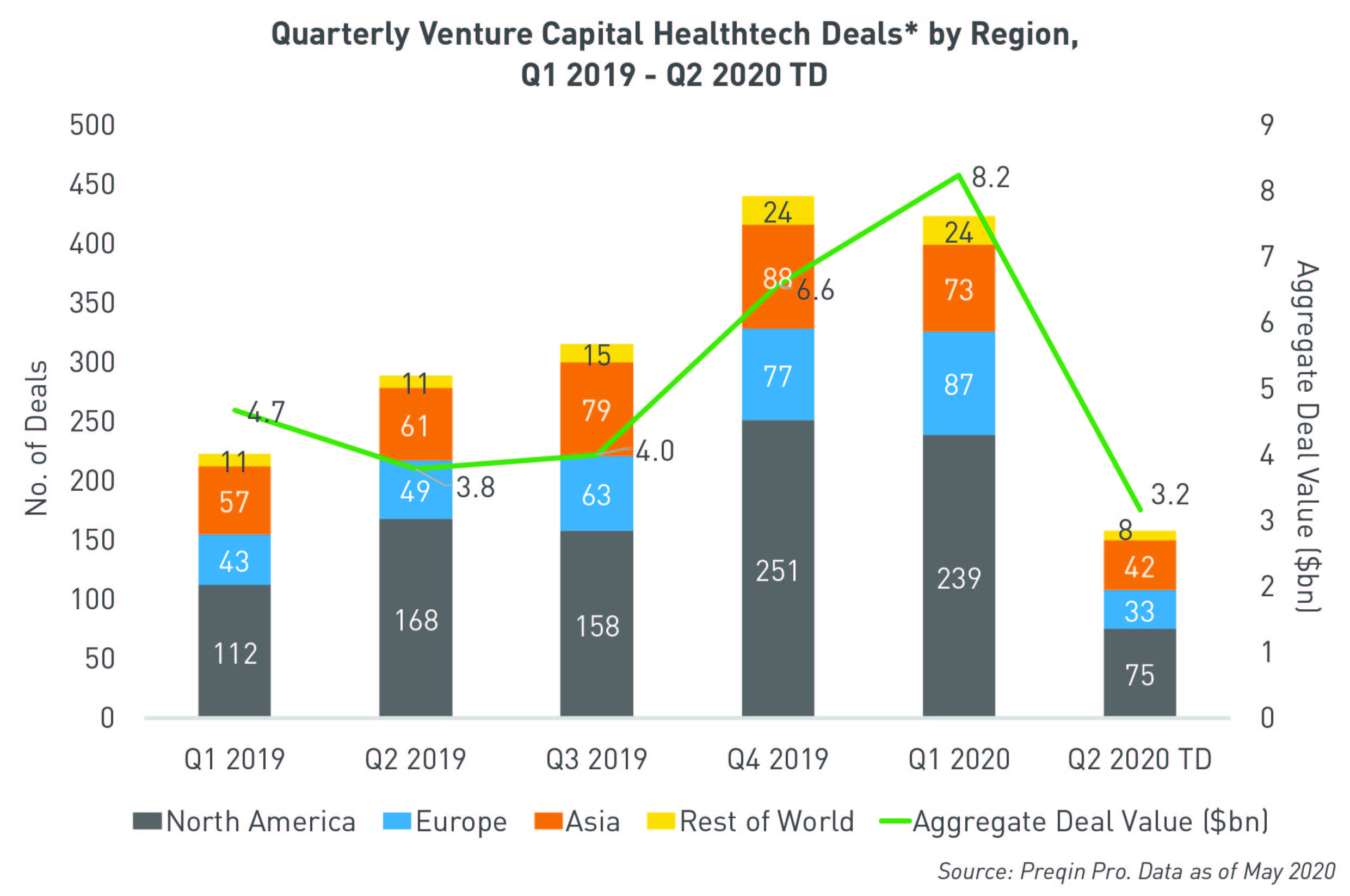
Preqin deals data reflects this growing trend. Between January and March 2020, the total value of global venture-backed healthtech deals jumped by 76% from Q1 2019 to hit $8.2bn. That’s a 25% increase in aggregate deal value compared with Q4 2019, and the highest quarterly total on record. North America dominated Q1 2020 deal activity, comprising 56% of the total number of deals, followed by Europe with 21% and Asia with 17%. Activity in Q2 2020 is also looking strong. Data as of 18 May shows Q2 2020 healthtech deal value at $3.2bn, on course to exceed the 2019 quarterly average of $4.8bn – despite the challenge of keeping business operations steady in a time of social distancing.
The Rise of Consumer-Focused Healthcare
The largest venture-backed healthtech deal completed in Q1 2020 was the $285mn Series E financing held by ClassPass Inc., earning the New York-based start-up a valuation of $1bn and therefore unicorn status. ClassPass Inc. partners with boutique studios, gyms, and wellness providers, offering members access to a global network of wellness-inspired experiences and the ability to digitally book classes or view on-demand workout videos. The latest financing round was led by L Catterton and Apax Digital, with additional participation from existing investor Temasek Holdings.
Just behind the ClassPass Inc. deal was the $250mn Series D financing for ScriptDash Inc., a San Francisco-based digital pharmacy that trades under the brand name Alto. Founded in 2015, the start-up operates a web and mobile platform enabling patients to do things like request refills, schedule the delivery of medications, or message a pharmacist via their digital device. ScriptDash’s financing, completed in January 2020, was led by new investor SB Investment Advisers, with participation from returning investors Greenoaks Capital, Jackson Square Ventures, Olive Tree Ventures, and Zola Capital Management, LLC.
These deals underscore the growing investor appetite for consumer-focused, personalized, digitally accessible health and wellness solutions. Digital technologies such as mobile internet are increasingly being deployed to provide consumers with fast, easy ways to look after their health.
How Healthtech Is Helping During the Pandemic
Prior to the outbreak of COVID-19, healthtech was already a flourishing industry. As we reported in the 2020 Preqin Global Private Equity & Venture Capital Report, investment in healthtech has been consistently high in recent years, as more and more GPs look for opportunities in this space. At $19bn, the total value of venture capital deals completed in the sector in 2019 fell just shy of 2018’s $20bn record.
At a time of mass quarantines, healthtech is playing a critical role in helping patients to access the information and medical services they need. London-based AccuRX is a prime example. AccuRX’s software solution provides a secure network for general practitioners to text vital information to their patients. In March, as the epicenter of the COVID-19 pandemic was shifting to the US and Europe, AccuRX built a video-calling solution over a single weekend. This solution is reported to have been used 400,000 times since its launch. AccuRX’s most recent investment came in the form of a £8.8mn Series A financing round in February 2019, led by UK-based investor Atomico.
In the US, KRY International AB, a Sweden-based digital health company, has rolled out a free video consultation platform in response to a spike in demand caused by the coronavirus pandemic. In January 2020, KRY International AB held a Series C financing round led by Ontario Teachers’ Pension Plan, raising €140mn.
In Asia, the Indonesian Government is using healthtech to ensure that patients can continue to see medical health professionals. The Indonesian Ministry of Health has launched virtual health consultation services and partnered with four unicorns, Halodoc among them. Jakarta-based start-up Halodoc develops and operates a mobile application that enables patients to virtually consult with physicians through video calls, voice calls, and chat. The firm held two Series B financing rounds in 2019, one in March raising $65mn, and one in July for an undisclosed amount.
The Future of Healthtech
2020 looks to be on track for record-high annual venture capital investment in healthtech. As a result of COVID-19, more alternative assets professionals are looking for opportunities in the healthcare sector. In our April 2020 survey of over 100 investors active in alternative assets, 36% said that they are targeting healthcare-focused investment in 2020 because of COVID-19’s impact. This is likely to drive even greater interest in digital health innovations that can offer users on-demand health and wellness services – all at the touch of a button.
For more insights and analysis on the impact of the pandemic on alternative assets, take a look at our COVID-19 Knowledge Hub.