

At Preqin’s latest webinar, LPs and GPs in Greater China discussed the key trends shaping the local private equity market, from regulatory risk to the rise of secondaries
At Preqin’s latest webinar, LPs and GPs in Greater China discussed the key trends shaping the local private equity market, from regulatory risk to the rise of secondaries
China is set to become the world’s largest economy by 2028. Despite global economic disruption, China posted GDP growth of 2% last year. Its private capital sector has total assets under management (AUM) of $1.4tn and will expand further with proactive government efforts to strengthen regulatory frameworks and establish a formal financial system. The country was also one of the first to recover from the pandemic, following decisive action by the authorities. While private equity opportunities abound, China’s changing regulations and continued tensions with the US are among the key challenges faced by industry players.
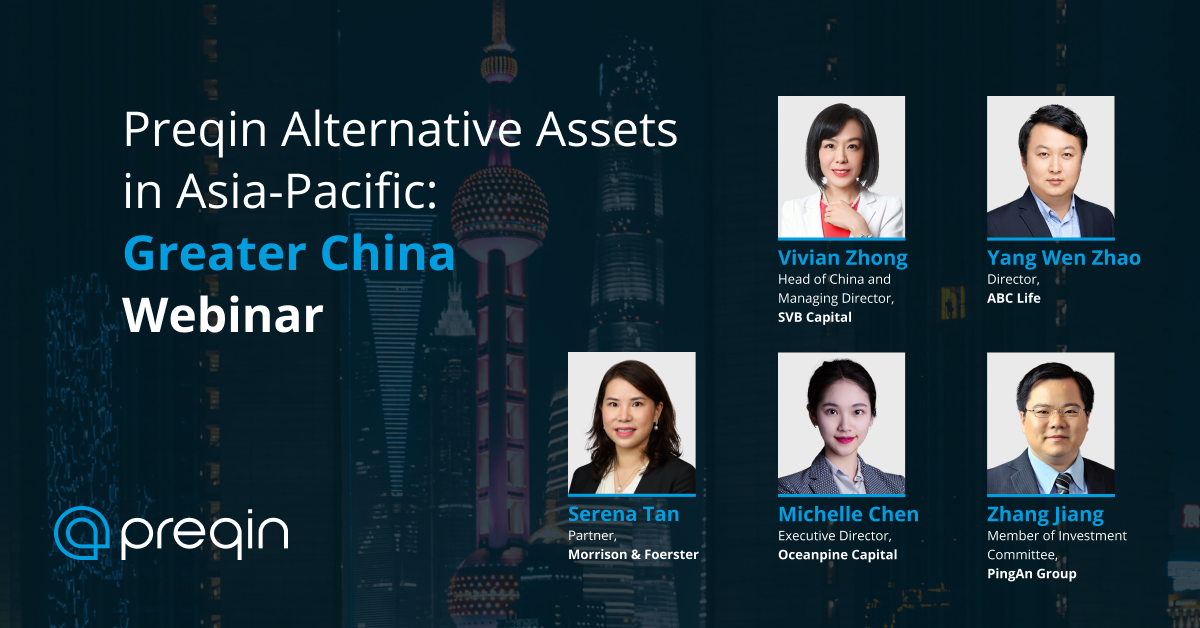
At a Preqin webinar on 19 August, we heard from panelists Yang Wen Zhao, Director at Agricultural Bank of China Life; Vivian Zhong, Managing Director at Silicon Valley Bank Capital; Michelle Chen, Executive Director at Oceanpine Capital; and Zhang Jiang, Member of Investment Committee at Ping An Group. The panel was moderated by Serena Tan, Partner at Morrison & Foerster.
Our panelists highlighted five key trends shaping Greater China’s private equity & venture capital (PEVC) industry and the growing secondary market:
1. China’s PEVC industry is becoming more specialized, giving rise to cross-sector innovation
Zhao: “Growth is still the main theme for the China PEVC industry. We now see that to profit from all stages of a company, venture capital investors who have traditionally backed early-stage innovative companies now invest money at the later stages, while private equity firms have also created venture capital departments. The boundary between the two strategies is blurring.”
Zhao adds that the industry is facing an impossible triangle: LPs need capital to be returned, GPs need to meet regulatory requirements, and portfolio companies need to make technological breakthroughs in subdivided industries. An approach that has recently emerged is cross-sector innovation, for example with solutions involving artificial intelligence and healthcare.
2. To minimize regulatory risk, GPs and LPs need to pay attention to the latest government policies and think long term
Zhang: “As a GP, it’s important to be prudent with new investment sectors, especially when analyzing related government policies. Given the political uncertainty, we believe in looking long term to produce a correct analysis. We also keep an eye on technological advancements because of policy changes like China’s push to boost domestic demand, as well as overall changes in consumer behavior.”
Despite the latest crackdown on US listings by the Chinese Government, Chen says: “We believe that Chinese companies that don’t have a VIE structure can still list in the US. Even if it’s under a VIE structure but not particularly large or sensitive, the SEC will require more disclosure but will still allow it.”
VIEs are variable interest entities, which refer to offshore shell companies that Chinese companies create to get around restrictions. VIEs can issue stock to public shareholders and raise money from exchanges.
3. Opportunities are still present in sectors that are aligned with China’s regulations
Chen: “China’s post-pandemic economy has recovered quicker than the rest of the world. In the first half of the year, we observed that the equity investment market has rebounded together with China’s economic recovery, which was evident in aspects such as fundraising, investment, management, and exits. Semiconductors, medicine, clean energy, and autonomous driving, as well as new consumer sectors, have seen the greatest growth.”
Chen adds: “In the future, Oceanpine Capital will go in the direction of China’s government policies, which are focused on building a strong country. For instance, carbon-neutral industries will prosper given China’s latest goal to achieve net-zero carbon emissions. China’s three-child policy will also drive demand for consumer goods, and its aging population will drive the healthcare industry. We believe these are opportunities that are present with the new policy changes.”
4. While the secondary market is still small, it’s set to grow
Zhong: “The secondary market is still small in China, but demand is high. This is because in 2014 and 2015 there were record numbers of funds set up. A good number of them are close to reaching the point of exit. But even as everyone expects to exit via IPO, the percentage of funds that are successful is quite small. There is strong demand, but the key concern now is pricing.”
5. China-focused LPs will use both sector and general funds
Zhao: “As an insurance company that invests, we include both sector and general funds to achieve a balance. This is because to achieve sustainable alpha, we need to ensure stable income. We need to adopt a macro view and adjust the allocations year by year to achieve breadth, depth, and synergy.”
Watch the full Preqin Greater China webinar recording (conducted in Mandarin Chinese). For more insight and data on China’s alternative assets markets, read Preqin’s Greater China-focused report, which covers private equity, venture capital, secondaries, and hedge funds.