
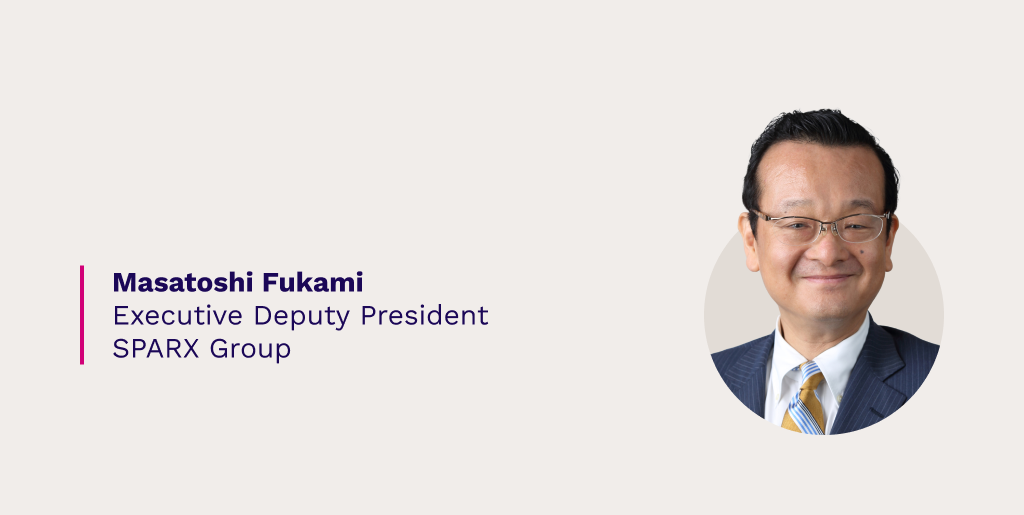
Preqin spoke with Masatoshi Fukami, Executive Deputy President of SPARX Group, to understand key growth factors in Japan’s private equity and venture capital industries
What is your view on the growth potential of Japan’s venture capital market?
We believe that Japan’s VC market offers a significant investment opportunity going forward. Although the total value of venture-related investments made in the US is much higher than Japanese markets, we see this massive difference as an opportunity. In 2021, US start-ups raised $389bn, compared to only $5bn raised by Japanese start-ups, which is 1/78th of the US total, according to Preqin Pro. Experts usually cite a lower number of start-ups and the fact that Japanese start-ups typically only focus on the Japanese market as two main reasons for this funding disparity. When comparing US and Japanese start-ups operating within the same industry, valuations for US start-ups are several times higher than for their Japanese peers. We believe that a number of Japanese start-ups are extremely undervalued.
The gap has potential to narrow in the future. The first sign of this is a change in the mindsets of the younger generation in Japan. Traditionally, talented undergraduates and young people viewed being employed by large corporations and the government as good career paths. However, in recent years, many talented young people have started their own businesses. Furthermore, these new businesses are focusing more on the global economy. These young founders realize that Japan has become a mature country, and if they want their companies to grow, they have to look to the international markets.
Secondly, compared to the rest of the world, the cost of hiring talented Japanese engineers is relatively cheap. In the latter half of the 20th century, Japan transformed into a major exporter, fueled by a cheap labor force producing high-quality goods.
The recent depreciation of the yen, combined with dramatic changes in Japan’s industrial structure, has increased the likelihood that the country’s global role will evolve. We believe that its start-ups will play a major role.
Lastly, the Japanese government is more proactive than before. One of the first priorities of Prime Minister Fumio Kishida’s new cabinet is to increase support for start-ups. The importance of such governmental involvement is critical, as is evident from neighboring South Korea, where government-backed funding and programs have helped the venture capital industry to flourish.
What is your view on the Japanese buyout market?
We expect buyout investment opportunities to expand rapidly in Japan. The two main opportunities are: (1) companies seeking to divest non-core businesses and (2) the business succession crisis faced by family-run companies.
First, Japan’s large corporations have been criticized for having too many non-core operations. Today, these companies are re-thinking how to treat their non-core and under-performing assets.
Executives increasingly face pressure from corporate governance reforms and active shareholders emphasizing the importance of return on equity (ROE). As a result, we are seeing more private equity funds completing carve-out deals. We believe that corporate management teams in Japan increasingly understand the role of private equity funds.
Second, many of the older founders who created their businesses in the postwar era are now reaching their retirement years. Due to Japan’s aging society, there is an overwhelming shortage of succession options from both ownership and management perspectives. Buyout funds are not only able to purchase a company’s shares, but they can also provide a support system for human resource development and establish systems for future business succession. We believe that buyout funds offer great benefits in terms of maintaining the business, preserving employment, and putting in place excellent technologies.
In addition, among small- and medium-sized manufacturers, trends such as carbon neutrality and the electrification of automobiles will likely lead to an active mergers and acquisitions market. As these trends accelerate, we expect buyout funds to play a major role.
What is your view of the Japanese market for renewable energy and other infrastructure funds?
We believe investment opportunities in Japan’s renewable energy and infrastructure markets will continue to grow. Today, Japan’s renewable energy industry is facing a major turning point. New solar and onshore wind projects, which have been expanding rapidly, are facing headwinds due to available land and power grid constraints. In addition, the feed-in tariff (FIT) scheme introduced in 2012, which jumpstarted the rapid development of renewable energy power plants in Japan, will be replaced by a new feed-in premium system, or FIP, starting this year. This system pays power producers a premium in addition to the market price for electricity which they generate instead of a fixed price under the FIT one. The new system will continue to incentivize a transition to renewable energy.
Even in this environment, we believe that there is room for growth in the small-scale biomass and geothermal power generation areas, which have not been widely considered in the past. In addition, there are opportunities to acquire solar and wind power plants that are already in operation, also known as brownfield investments. We are increasingly seeing that corporations need to divest their existing solar and wind power plants from their balance sheets, thus an increasing number of these types of projects are becoming available on the secondary market.
In addition to renewable energy, the Japanese government is planning to expand its support for hydrogen and storage batteries - technologies in which Japan maintains a technological advantage. We are actively considering investment in this field ahead of our competitors amid the global carbon neutrality trend.
How will SPARX Group thrive in the Japanese private capital market in the future?
SPARX started to build its private equity business following the 2011 Great East Japan Earthquake, which severely damaged the Japanese economy and negatively affected the lives of many living in the Tohoku region. With support from our cornerstone investors – Toyota Motor Corporation and Sumitomo Mitsui Banking Corporation – we first launched our renewable energy infrastructure strategy. Since then, we started the Mirai Creation strategy, which invests in start-ups around the world, and continue to expand our business. This now includes the Space Frontier Fund, which invests in start-ups focused on space, and the Japan Monozukuri Mirai Fund, which buys manufacturing companies with superior technology and aims to increase their corporate value. Over the past few years, our renewable energy infrastructure and venture capital strategies have grown to become some of the largest in Japan
About
SPARX Group operates an asset management business and an investment advisory business. Since its founding in 1989, SPARX Group has created new investment strategies for global investors seeking to capitalize on Japanese investment opportunities. It invests through a number of innovative strategies on behalf of a wide cross-section of investors around the globe. Its clients include corporate pensions, government entities, private and trust banks, and public pension funds.