

Carbon capture and energy storage have become main focuses for VC in 2022
Carbon capture and energy storage have become main focuses for VC in 2022
Imagine a world that runs on clean, renewable energy. People commute via electric transportation that doesn’t rely on fossil fuels. Excess carbon dioxide is captured from the air, keeping emissions at a manageable level. To enable this carbon-net-zero future, new innovations and technologies must be launched and implemented fast.
Venture capital can be part of the climate finance toolset, with its track record of backing emerging cleantech in angel and seed stages. These new technologies have addressed long-term trends in the past decade and attracted larger late-stage financing rounds from a variety of investors, including sovereign wealth funds, government-backed VC funds, state agencies, and corporate investors.
Financing the transition to net zero will be one of the key themes discussed at COP27, the annual event where world leaders, activists, and CEOs discuss and negotiate how to act against climate change. This year, COP27 is taking place from November 6 to 18 at Sharm el-Sheikh in Egypt. Aside from discussions about how to mitigate and adapt to climate change, developed countries will be asked to provide financial aid to developing countries that have contributed the least to climate change yet are the most vulnerable to natural disasters.
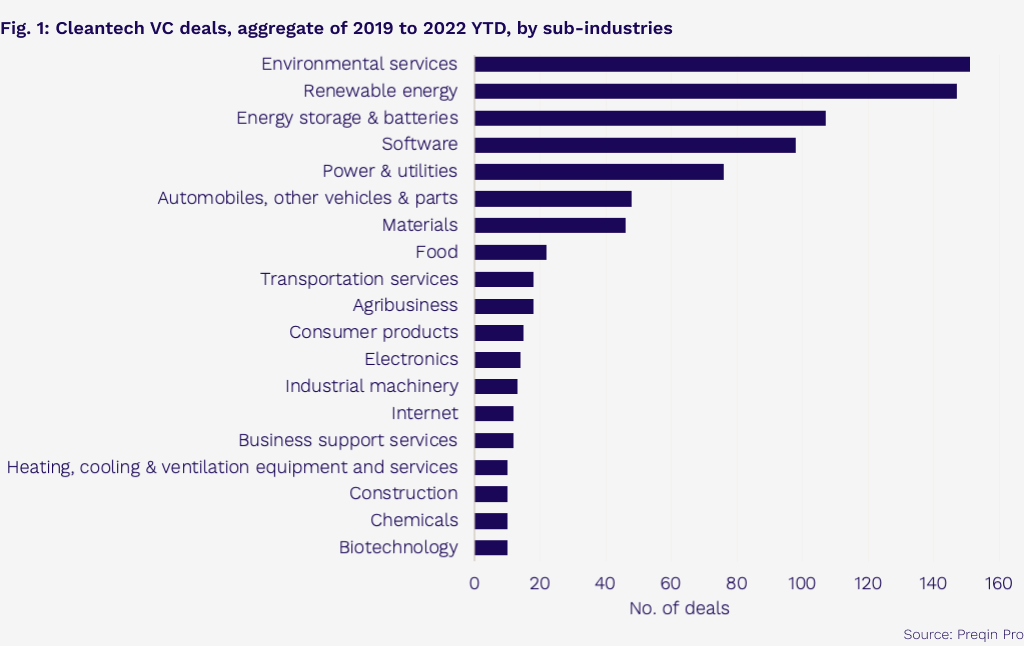
Recently, most venture capital deals have been made in the key sub-industries of environmental services, renewable energy, and energy storage and batteries (Fig. 1). In this article, we showcase three specific areas where VC-backed clean technology start-ups and investors have been making an impact in recent years.
1. Environmental services: Carbon capture
Carbon capture technologies directly capture carbon from the air, a pressing need given the current record levels of greenhouse gases in our atmosphere.
2. Renewable energy: Carbon-free power generation
As the world steers away from burning fossil fuels, alternative sources of energy and electricity have become crucial. Carbon-free power generation includes nuclear, hydrogen, solar, and wind power.
3. Electric vehicles and airplanes, and energy storage & batteries
When President Biden was elected in 2021, he set an ambition for 50% of all vehicles sold in the US to be electric by 2030, spurring increasing investment into the EV sector. In a similar vein, China has imposed a mandate on its automakers in hopes of having 40% of EVs make up all sales by 2030. These policies have encouraged a global injection of venture capital into EV manufacturing, from cars and bicycles to airplanes.
Electric transportation needs batteries to run. The mass implementation of renewable energy will also rely on stable energy storage to reliably supply electricity harnessed from natural phenomena like solar and wind. Some examples of venture capital-backed energy storage and batteries companies include California-based Sila Nanotechnologies, and China-based Contemporary Amperex Technology and Sunwoda EVB.
Venture capital is at the forefront of innovation and has been backing the clean technology sector over the past decade. As climate finance becomes a hot topic in the wake of COP27 talks, one possible solution is for venture capitalists to look into deploying capital to clean technology start-ups in developing countries with fewer resources. With its track record of backing new-generation technologies, venture capital has both the knowledge and resources to spur climate technologies that the world sorely needs.