

Gender inequalities were exacerbated by the pandemic, but workforce participation in alternatives is slowly improving
Gender inequalities were exacerbated by the pandemic, but workforce participation in alternatives is slowly improving
“None of us will see gender parity in our lifetimes, and nor likely will many of our children.” That was the World Economic Forum’s sobering conclusion after presenting its Global Gender Gap Report 2020, and the 2021 version is even more damning. With COVID-19 deepening pre-existing inequalities, the income and gender gaps in the world of work have both widened globally.
The Gender Gap Report looks at inequality between men and women (as most research focuses on just two genders, we’ll not address non-binary participation in the workforce in this instance) across a wide number of criteria. In Preqin’s Women in Alternative Assets 2021 report, we focus on employment to understand the level of female representation across the alternatives industry.
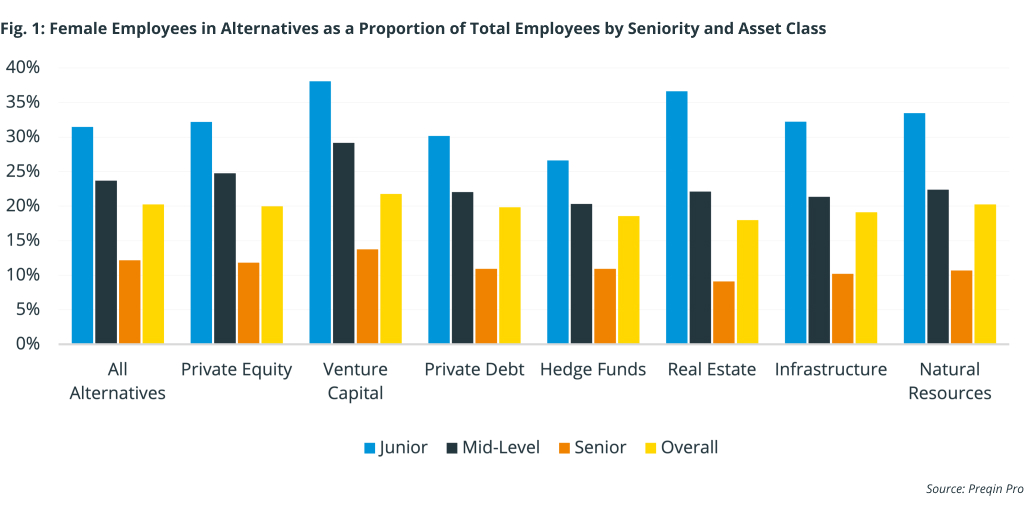
Our 2021 study found that less than a quarter of people working in alternative assets are women. Senior ranks in particular lack female representation: women accounted for just 12.2% in 2021 (up from 11.9% in 2020) – and there isn’t a huge amount of regional variation, either (Fig. 1).
This is low in comparison to other areas of finance, as in financial services worldwide, where 31.3% of senior management roles were filled by women over 2019-2020, according to the World Economic Forum. This is a slight increase from the 28.9% hired in senior roles from 2015 to 2019.
The finance sector struggles with ‘leaky pipeline syndrome’ – the drop in retention and promotion of women – despite intake in junior roles often being spread fairly equally between men and women. This is common across a number of fields. In the US, for example, just 5.4% of CEOs at S&P 500 companies are women as of 2020.
The start-up world fares similarly. A study into fintechs showed that women founded just 7% of fintechs worldwide.
However, there are initiatives in place to tackle the issue. The UK Treasury’s Women in Finance Charter, for instance, has over 330 signatories, including asset managers, banks, and insurers.
And things are improving in business. Deloitte estimates that the percentage of female executives worldwide is expected to grow from 22% in 2019 to 31% by 2031, but notes that women still manage “only single-digit percentages of client assets” in financial services, “this being an obvious next area of opportunity for the industry’s use of women’s abundant skills.”
Financial services has also documented some recent improvements. A ranking of the top 20 global financial services companies in July 2021, taken from the Fortune Global 500, reported that nearly a quarter (23%) of the executive committee places were held by women, up from 18% in 2018.
Interestingly, Preqin’s 2021 Women in Alternative Assets report showed that venture capital also has the highest levels of female employees when compared to other asset classes (Fig. 2). This could also explain why venture capital has the largest proportion of women in senior roles.
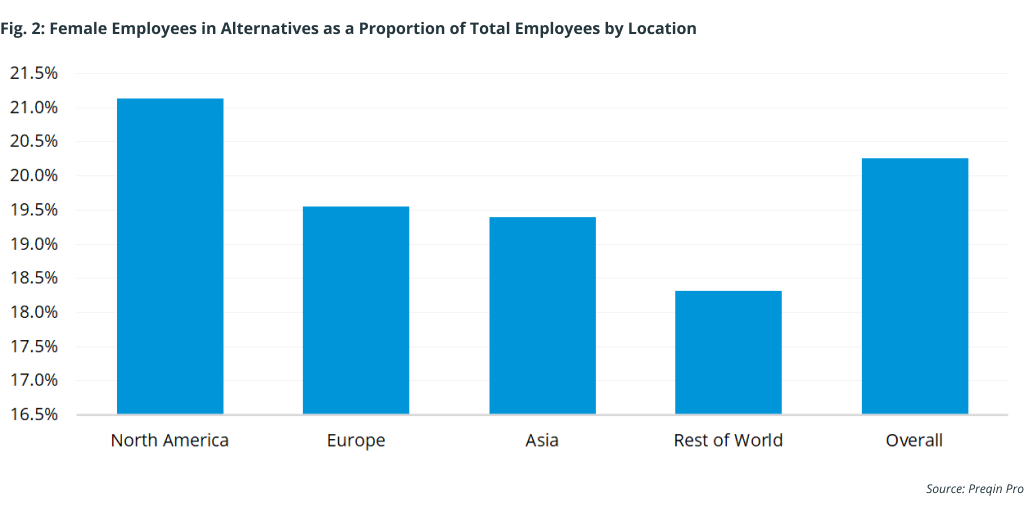
Drawing wider industry conclusions is difficult, but within alternatives, the picture is clearer. Overall, women are underrepresented at all levels from junior to senior. But there are some bright spots. Deloitte’s study names intentional recruitment, innovation in retention, and supportive re-entry as huge drivers behind the increase in women in financial services, as well as mentoring, sponsorship, and strong peer networks. Knowing there are solutions is often half the battle.
To learn more about the gender gap, take a look at our Preqin Impact Report: Women in Alternative Assets 2021.